

Research
Our reseach activities center around the "SUPERNOVA PROBLEM". It concerns the death of massive stars (i.e. stars that are more than 10 times as massive as the sun) and, in particular, the understanding of the physical processes involved. Such events are the most energetic outbursts in the modern universe with an energy output in excess of an entire galaxy - containing billions of stars - for the period of several months. The understanding of such events requires a profound knowledge about all four fundamental forces of nature - gravity, electromagnetism, strong, and weak interactions - as well as large scale numerical modeling. Supernovae are also an ideal site to probe the yet incopmpletely known state of matter, in particular at extreme conditions that are inaccessible otherwise, e.g., in terrestrial experiments.
Complete list of publications can be found here:
NASA ADS
/
INSPIREHEP

2024 - 2028: OPUS-25 2023/49/B/ST9/03941, entitled
"Unravelling the mechanism of massive stars explosions
with hot and dense phases of matter at extreme conditions"
PI: Tobias Fischer
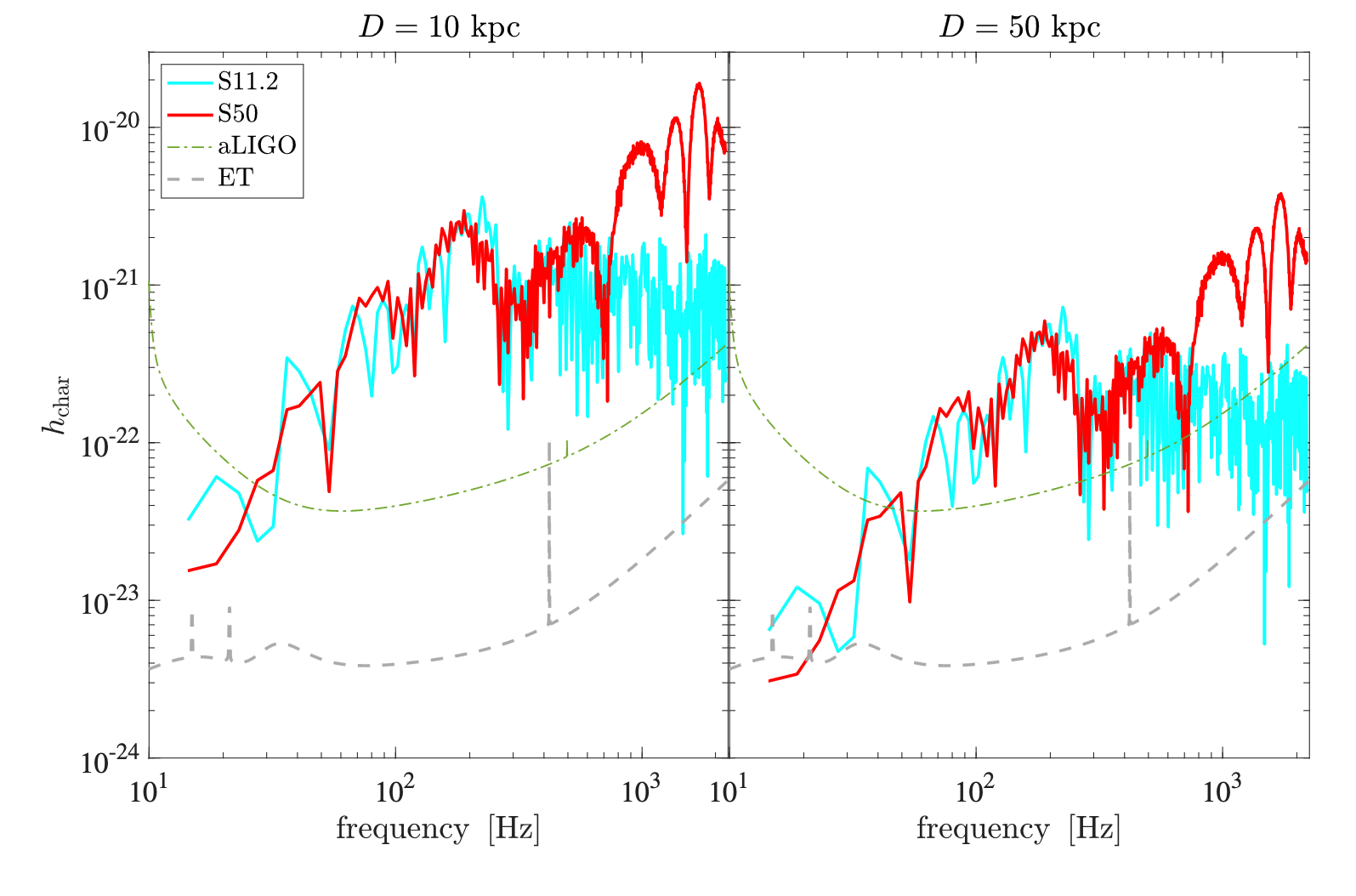
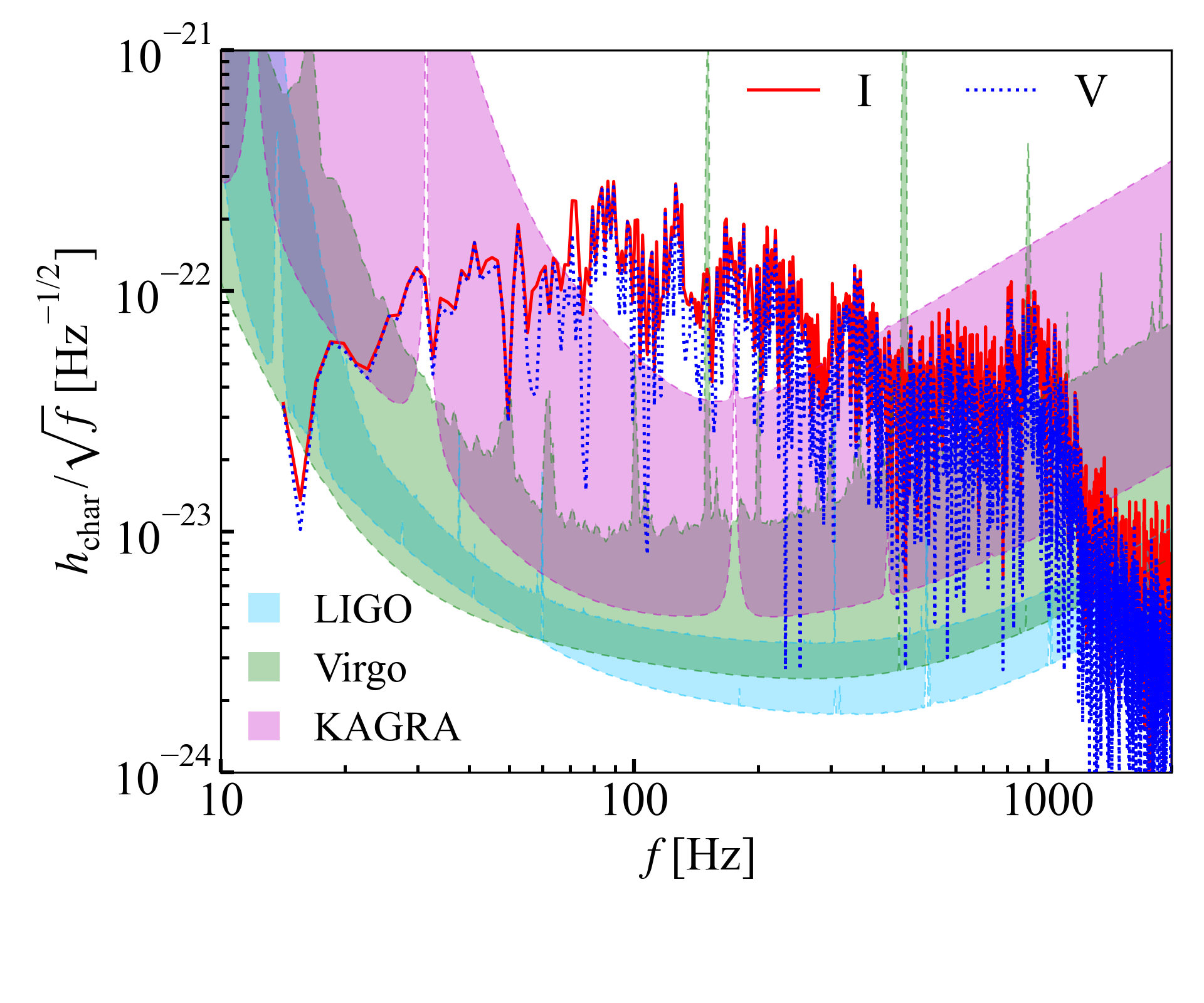
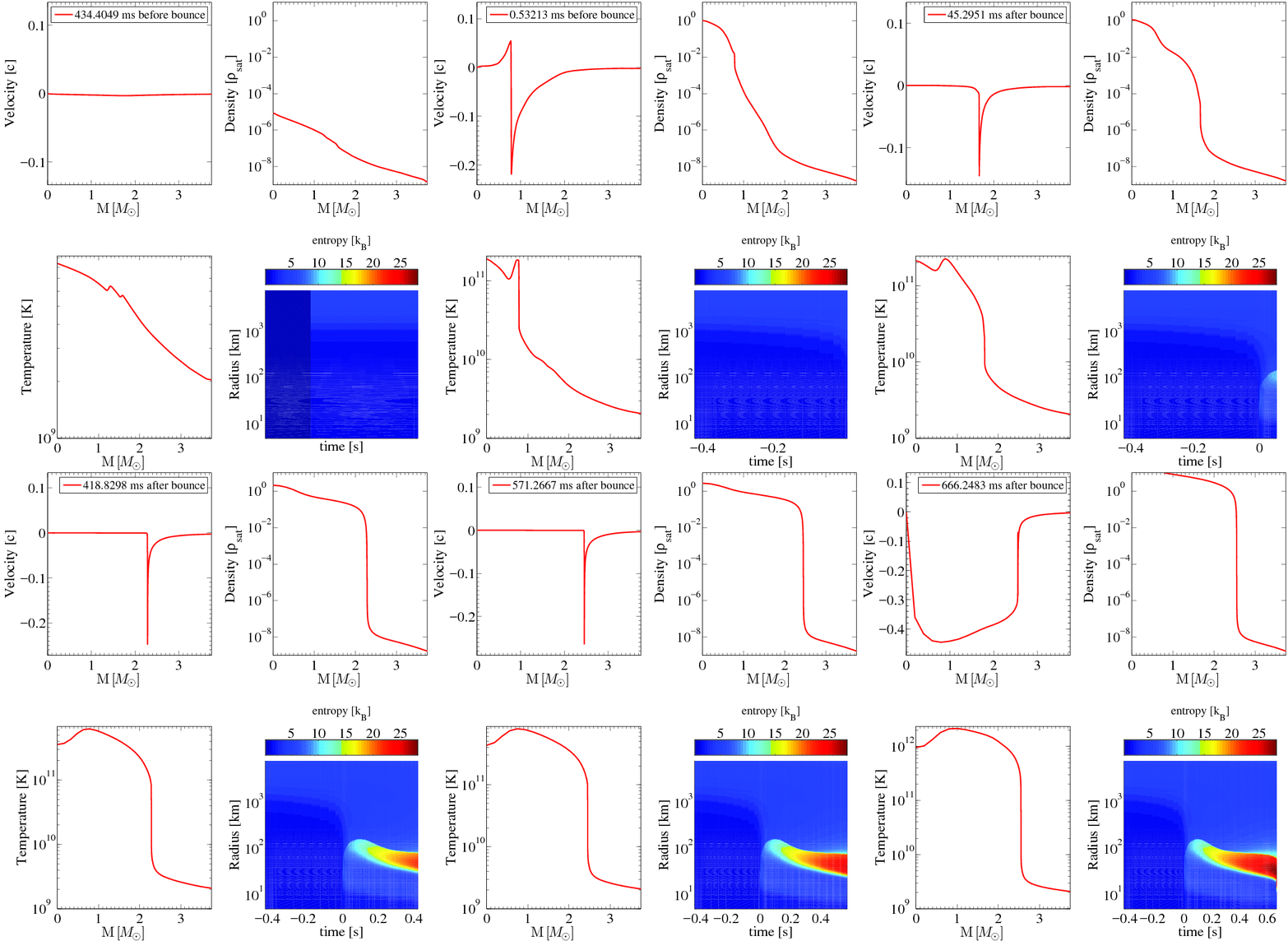
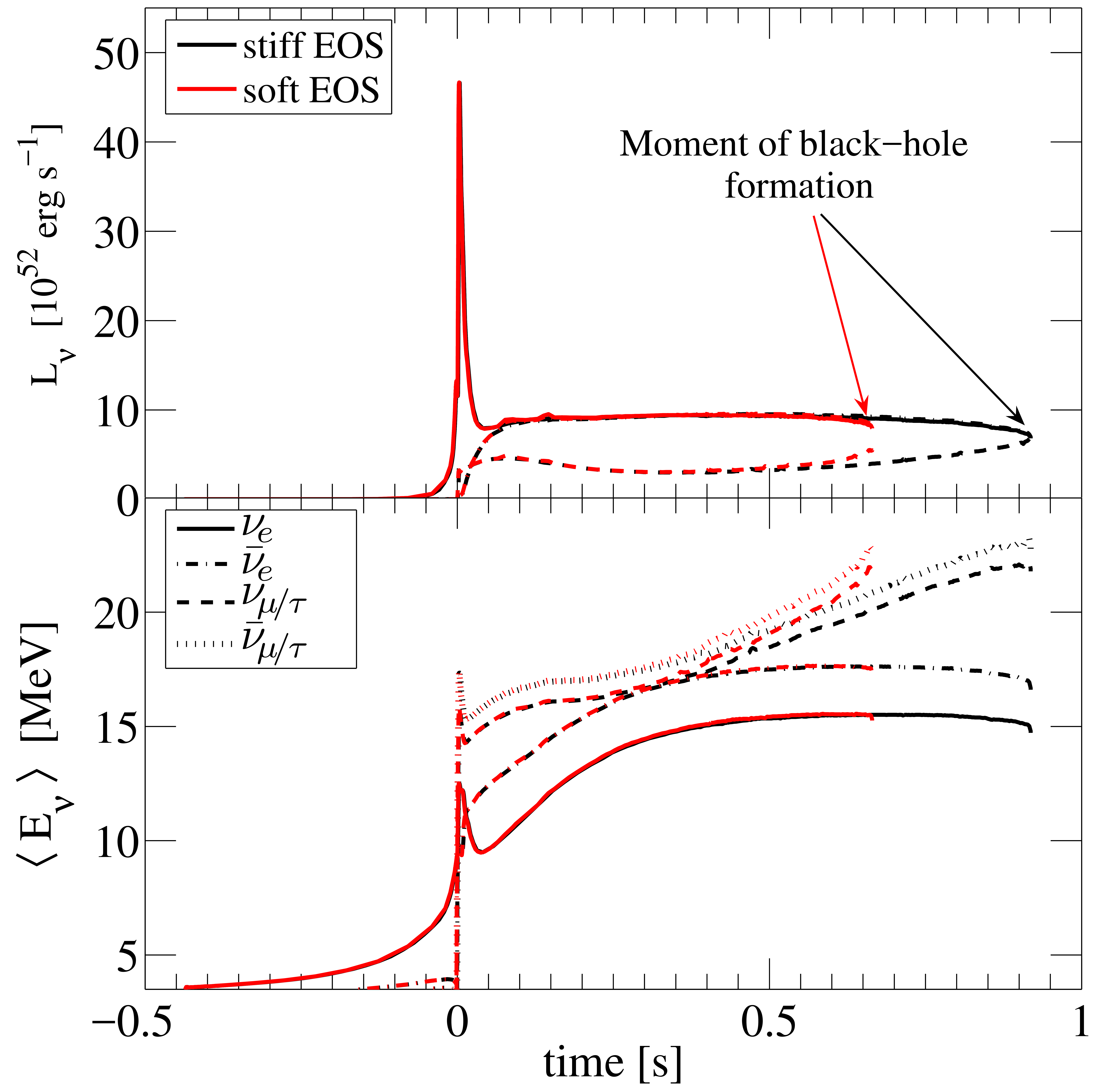
Failed core-collapse supernovae and subsequent black-hole formation
In the absence of an earlier supernova explosion, continuous mass accretion onto the central
protoneutron star will eventually lead to the formation of a solar mass black hole, on a
timescale of several 100 milliseconds up to few seconds, for stellar progenitors in the
zero-age main sequence mass range of 40 to 50 solar masses. Details of this scenario depend
on the equation of state (EOS) and can be probed via the neutrino luminosities and spectra.
Astron. Astrophys. 499, 26 (2009)
Equation of state
The large variety of conditions which are covered by the supernova equation of state
range from low temperatures ≤ 0.5 MeV, where time-dependent nuclear reactions determine
the composition, towards complete chemical and thermal equilibrium known as NSE (nuclear
statistical equilibrium) with increasing temperature. In NSE, the nuclear
composition is determined by the following three independent variables: temperature,
rest-mass density (or baryon number density), and charge density. With increasing rest-mass
and charge density, nuclei become heavier and more neutron rich, as a consequence of electron
captures on protons bound in nuclei.
At normal nuclear density as well as above temperatures of about 10 MeV, nuclei dissolve at
the liquid–gas phase transition into homogeneous nuclear matter.
Publ. Astron. Soc. Austr. 34, e064 (2017)
An interesting consideration is the possibility of a phase transition,
from normal nuclear (in general hadronic matter) to the quark-gluon plasma.
If such transition is of first order, i.e. featuring an unstable hadron-quark
matter co-excistence region, then it might yield an observable signature in the
neutrino signal.
Nat. Astron. 2, 980 (2018)
Development of neutrino transport methods and weak interactions
Boltzmann transport equation for ultra-relativistic particles:
Evolution of the neutrino phase-space distribution functions within the general-relativistic
framework -- left-hand side: phase space deriavtive (transport) -- right-hand side: collision integral
Phys. Rev. D. 94, 085012 (2016)
In astrophysical applications, e.g., in multi-dimensional supernova simulations,
it is indispensable to develop approximate neutrino-transport schemes due to the
present computational limitations.
Astrophys. J. 698, 1174 (2009)
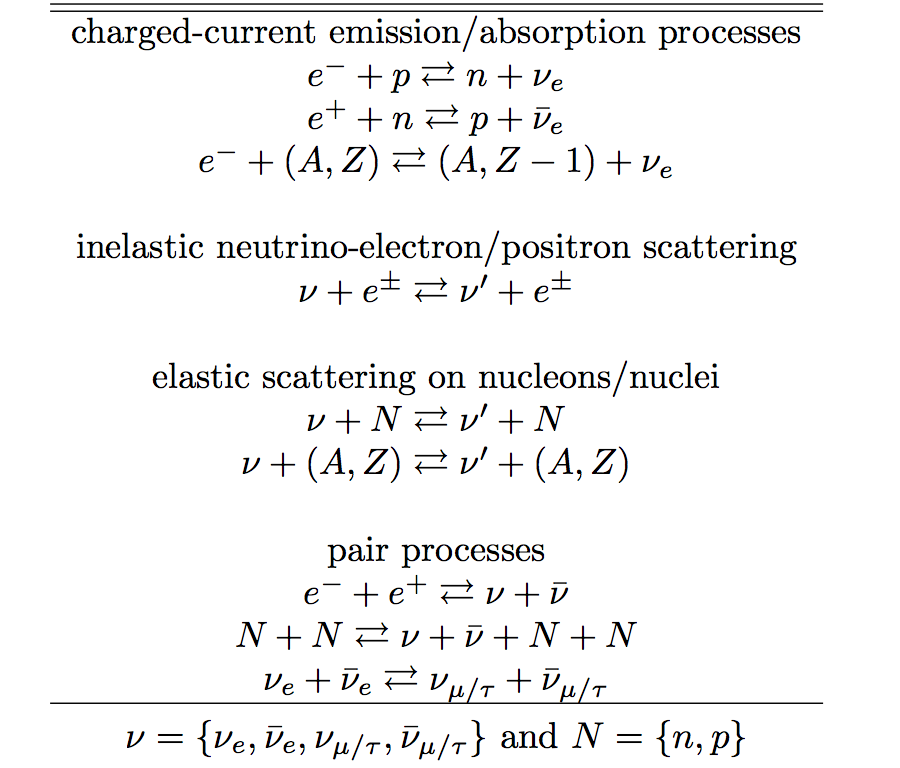
Set of standard neutrino-matter interactions that are considered in simulations
of core-collapse supernovae. Weak processes under supernova conditions are modified
by the nuclear medium.
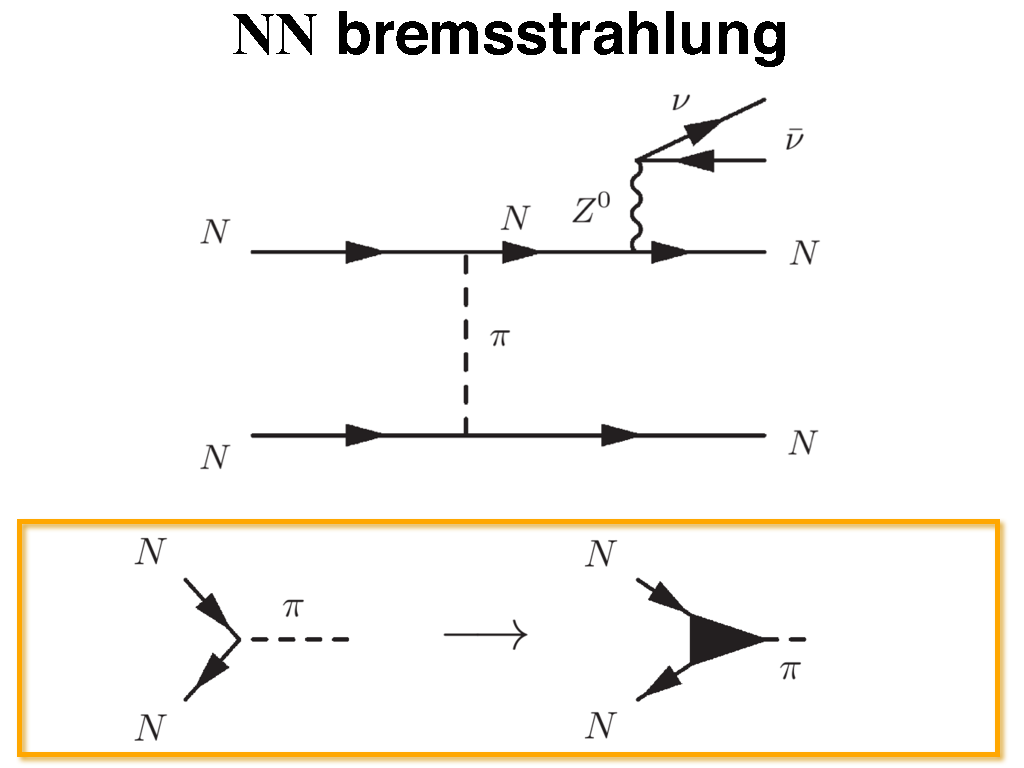
In particular reactions which involve neutrons and protons have a strong
medium dependence. Beyond the mean-field treatment, the dominant modification
is due to the dressing of the vertex function.
Astron. Astrophys. 593, A103 (2016)

The origin of the elements: explossive nucleosynthesis
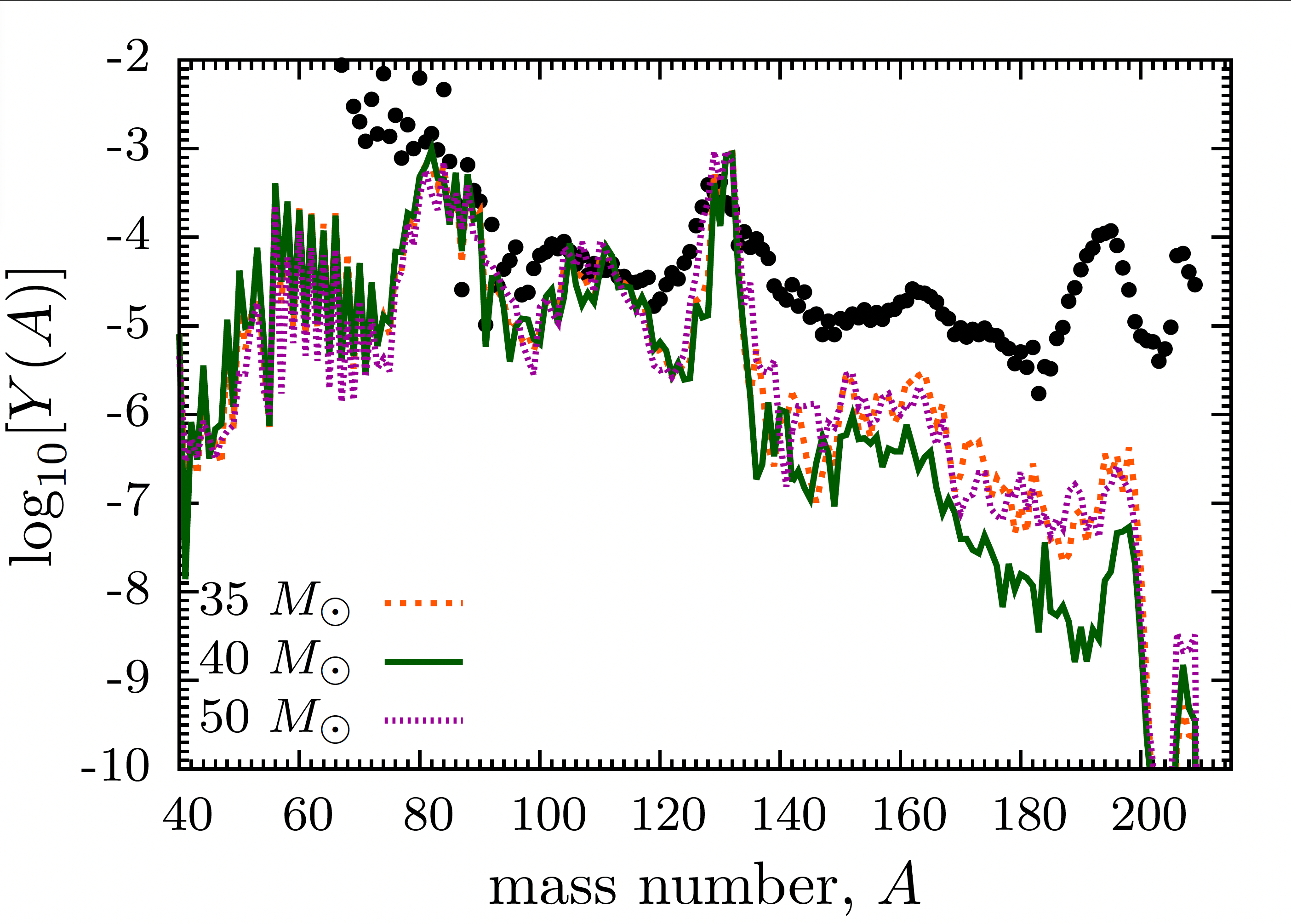
The astrophysical origin of the heavy elements remains one of the most active uncertainties in nuclear astrophysics. While both core-collapse supernovae and binary neutron-star mergers are capable of driving rapid neutron-capture (r-process) nucleosynthesis, their relative contributions to the Galactic inventory of heavy nuclei are still debated. Neutron-star mergers are now confirmed sites of r-process production through multimessenger observations of kilonovae, yet their event rates and delay times appear insufficient to explain all of the earliest heavy-element enrichment. Conversely, core-collapse supernovae are far more common and prompt, but whether canonical explosions, magnetorotational jets, or other rare channels can robustly synthesize the heaviest nuclei is unsettled. Clarifying the balance between these channels is central to understanding how — and on what timescales — the periodic table was assembled in the universe.
Astrophys. J. 896, id9 (2020)
/
Prog. Part. Nucl. Phys. 137, 104107 (2024)
Galactic Chemical Evolution with r-process elements
One of the greatest mysteries in modern physics is trying to find the site
of the rapid neutron capture process (r-process). Although the detection of
gravitational waves (GW170817), followed my kilonova (SSS17a) has confirmed
neutron star mergers as an r-process site, this site is likely not the only
r-process site. In order to merge two neutron stars, these would have to have
been produced in two individual core-collapse supernovae (red arrows) beforehand.
Two events that produce a lot of iron. This iron, however, would already be
imprinted in the next generation of stars, even before the two neutron stars
can collide and eject r-process elements.
On the other hand, it has been shown that already low metallicity stars can
contain vast amounts of r-process elements (yellow box).
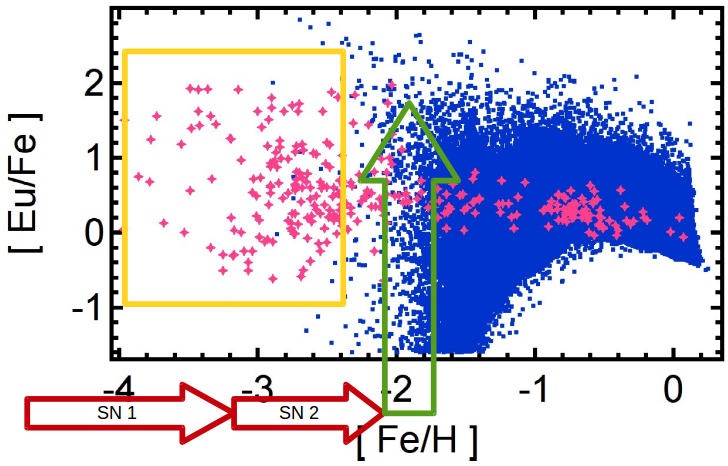
We are using state-of-the art galactic chemical evolution models to study
whether rare types of supernovae (so called "hadron-quark transition supernovae",
developed in-house at UWr) could be the missing second r-process site besides
neutron star mergers.
Fig.: Schematic of our research -- Magenta stars represent observations.
Two neutron stars are produced in two core-collapse supernovae (red arrows),
only then they can merge under the ejection of r-process elements (green arrow).
We modelled this approach with a three-dimensional galactic chemical evolution
model. Model stars are in blue.
The low metallicity, high r-process enhancement region (yellow box) observed
in halo stars is inaccessible with this classical approach.